












OpenAI and Anthropic allege improper distillation of their models. Investors have pushed Chinese AI valuations sky-high anyway—raising a harder question about pricing power.
By Phoebe Liu
Anthropic isn’t just sparring with Washington over military use of Claude. It’s also accusing Chinese AI labs of siphoning off value from it.
Last month, OpenAI and Anthropic publicly alleged that Chinese AI companies have been improperly extracting capabilities—coding, reasoning and other behaviors—from their proprietary models to train their own competing models, using a technique called “distillation.” In a February 23 press release, Anthropic claimed DeepSeek, MiniMax and Moonshot AI prompted its Claude models 16 million times through roughly 24,000 fraudulent accounts. Earlier this month, OpenAI sent a letter to U.S. lawmakers alleging that DeepSeek similarly improperly trained their models on outputs from OpenAI’s models. Google’s threat intelligence arm, without naming a company, warned in a February report of a rise in distillation attacks targeting Gemini.
The accused companies have not publicly commented on allegations of wrongdoing, and didn’t respond to Forbes’ requests for comment. But the broader point is hard to ignore: Several of these Chinese models are now nearly as good as their American counterparts. Many are open source. Most are cheaper. And that combination is starting to erode confidence in the expensive economics of the entire sector.
“It’s not easy to build these models, and [distillation] is a way to leapfrog that process,” says John Hultquist, chief analyst at Google’s Threat Intelligence Group.
Jenny Xiao, a venture capitalist at Leonis Capital who formerly worked on trust and safety at OpenAI, is more blunt: “Open source models are essentially a kill line.”
While American labs warn about intellectual property violations, Chinese AI stocks are running hot. MiniMax and Z.ai (not named in the U.S. companies’ claims) went public in Hong Kong in January, minting new billionaires. Skyrocketing shares have since catapulted the net worths of MiniMax chairman and CEO Yan Junjie and Z.ai chairman Liu Debing to $7.1 billion and $8.7 billion, respectively—roughly in the range of Anthropic’s seven billionaire cofounders, now worth $7 billion apiece.
There are others. Z.ai’s runup makes Liu’s cofounder, Tsinghua University professor Tang Jie, a new billionaire as well, worth $1.9 billion. DeepSeek founder Liang Wenfeng debuted this year as the richest newcomer on Forbes Asia’s China’s 100 Richest list, worth an estimated $11.5 billion. And Moonshot AI founder and CEO Yang Zhilin is set to become a billionaire when the Kimi model maker’s current funding round, reportedly at a $10 billion valuation, closes. Based on comparative valuation metrics, Wang Xiaochuan of Baichuan and Jiang Daxin of Stepful may have entered the billionaires’ club as well.
VCG/VCG via Getty Images
On the American side, private investors now value Anthropic and OpenAI at $380 billion and $840 billion. Neither has gone public yet, but when they do, today’s paper wealth will face a market test.
The tension underneath all this money: distillation allows an exponentially smaller model to learn quickly and efficiently from a larger model, so a distilled model can reach 80-90% of a frontier model’s performance with far less computational demand. That lowers operating costs, effectively accelerating a price war. For example, Z.ai’s GLM-5, released in February, costs roughly five times less per input token and 10 times less per output token than Claude’s Opus 4.6.
Distillation alone won’t create a great model. It requires a strong base model and serious engineering talent as well. But it certainly helps flatten the field.
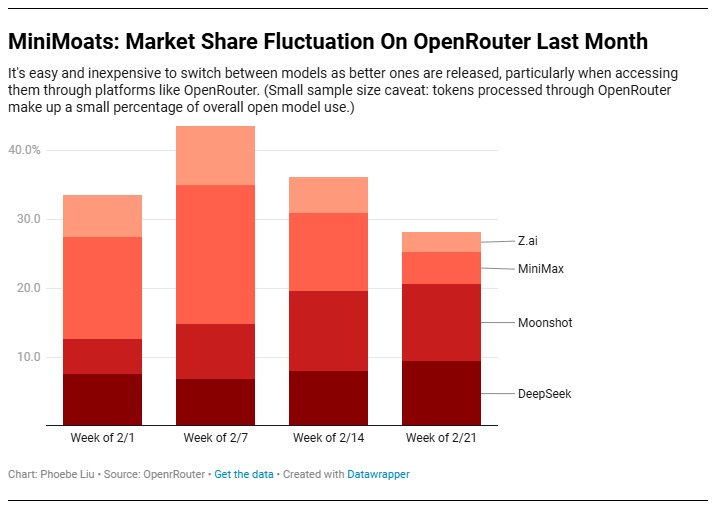
Distillation or not, Chinese labs appear to be gaining share. The top open models are Chinese, and among American startups that use open models, 80% rely on Chinese ones, Andreessen Horowitz general partner Martin Casado told Forbes last month. Switching costs are minimal; developers can toggle between models through major cloud providers or platforms like OpenRouter with little friction.
“If anything, it’s causing investors to think about future value that these labs bring,” says D.A. Davidson analyst Alexander Platt. “What’s going to happen to the pricing power of these American labs?”
Xiao puts it more directly. “You don’t need the smartest model to do average enterprise workloads, and you don’t really need to have a PhD to be a personal assistant,” she says. “ If your performance is not as good as the best open-source models, then regardless of what kind of fancy technique you have, no one’s gonna pay for it. And your valuation essentially goes to zero.”
Cracks are already starting to show. Z.ai (formerly Zhipu) and MiniMax are trading at meme-stock revenue multiples of around 400x and 550x, respectively, more than double that of OpenAI and Anthropic when they were valued similarly. Share prices are down 24% and 22%, respectively, from their peaks last week.
For open-source models, it’s hard to tell where the value really is, because the cost to switch between models is near zero, says Platt. Many developers can easily toggle between open-source models through major cloud providers as well as platforms like OpenRouter. Their closed-source counterparts—OpenAI and Anthropic, but also Thinking Machines Lab ($12 billion valuation), Safe Superintelligence ($32 billion valuation)—have more to prove as well.
“It’s the wild west on pricing,” says Dan Gray, research lead at private investing platform Odin.
Commoditization happens in every industry. There are echoes of the dot-com boom and the price war between Chinese and American electric vehicle companies from a few years ago. A similar pattern is shaping up in the AI chip industry. Potential IPOs for OpenAI and Anthropic this year or next will be a litmus test. Some companies, like Amazon of two decades ago, will come out stronger. Others will fall; it’s just a question of who and how far.
Originally published at Forbes
