













By Timothy Wilson
In an era where Silicon Valley folklore glorifies the college dropout as the ultimate startup archetype, Ace Yip is building something different—not just an AI company, but a counter-narrative.
At just 18 years old, Yip is the founder and CEO of ’Sup (also known as Sup Career), an AI-driven career technology startup designed to help students and early-career candidates navigate an increasingly brutal recruitment landscape. While headlines often celebrate founders who abandon formal education in pursuit of billion-dollar dreams, Yip is unapologetic about her choice to stay in school and pursue a university degree. For her, entrepreneurship and education are not mutually exclusive—they are complementary.
Building a Startup Before Graduation
Yip began building ’Sup in early 2025, while still a student at Raffles Institution in Singapore. The idea emerged from personal frustration. As a high-achieving student interested in law, she found the internship market oversaturated and opaque, with students often disadvantaged not by lack of talent, but by lack of access, guidance, and networks.
Rather than accept this as the norm, she chose to build a solution.
Launched publicly in July 2025, ’Sup positions itself as a “full-stack career copilot.” The platform uses AI to help students refine resumes, prepare for recruitment, and build meaningful professional connections—tools traditionally available only to those with elite networks or expensive coaching.
By late 2025, the startup had expanded to 15 campuses across Singapore and the United States, assembled a globally distributed team, and entered the process of raising an angel investment round. For a company founded by a high-school student, the traction was striking—but for Yip, it was only the beginning.

Rejecting the Dropout Myth
Despite her early momentum, Yip has been clear about one thing: she does not believe dropping out of school is a prerequisite for startup success.
The “dropout playbook”—popularized by stories of founders who left college to build tech giants—has become almost prescriptive in startup culture. Yip challenges this narrative head-on. She argues that the myth is not only outdated, but misleading for young founders who assume that abandoning education is a badge of seriousness or ambition.
For Yip, college represents structured learning, intellectual growth, and proximity to the very users her company serves. Campuses are living laboratories for ’Sup—places where she can observe recruitment pain points in real time, test solutions, and iterate quickly. Education, in her view, sharpens her entrepreneurial edge rather than dulling it.
She plans to take a gap year before attending university, with interests spanning law and data science, fields that mirror her startup’s intersection of technology, systems, and human opportunity.
Discipline, Not Romantic Chaos
Running a startup while completing high school is not glamorous, and Yip doesn’t pretend otherwise. Her days are tightly structured: early mornings, school hours fully dedicated to academics, and evenings reserved for product development and team coordination across time zones.
She credits compartmentalization as a survival skill—being fully present as a student during school hours, and fully present as a founder afterward. This discipline stands in contrast to the romanticized image of founders operating in constant chaos. Yip’s approach is deliberate, measured, and sustainable.
A Broader Definition of Success
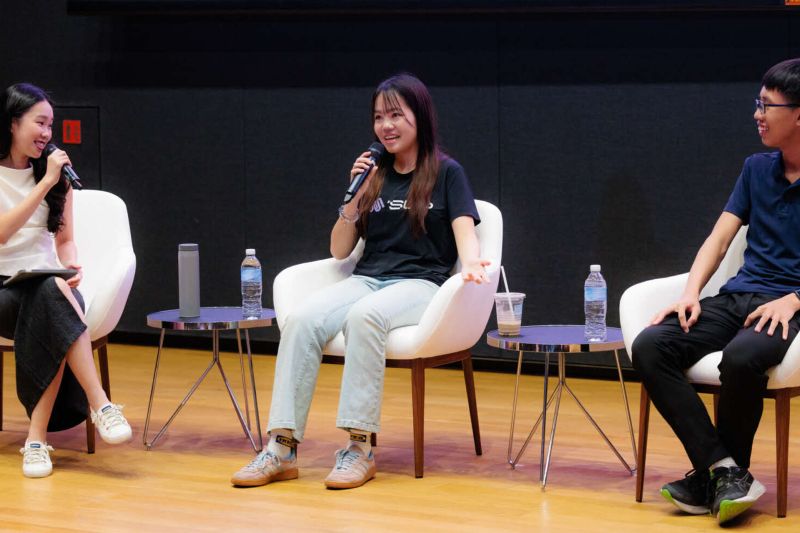
Before founding ’Sup, Yip was already a standout student leader. She was deeply involved in Model United Nations, serving as a Head Chairperson at the Global Youth Leaders’ Summit and coaching students at Raffles Girls’ School. These experiences shaped her leadership style—global in outlook, systems-oriented, and deeply focused on empowering others.
That same philosophy underpins ’Sup. The company is not just about helping individuals land jobs; it is about rebalancing opportunity in a system that often rewards privilege over potential.
Writing Her Own Playbook
Ace Yip is not rejecting ambition—she is rejecting imitation.
By choosing to build a serious AI startup while staying committed to education, she is redefining what early-stage entrepreneurship can look like. Her story suggests that the future of innovation may belong not to those who follow the loudest myths, but to those who quietly design their own paths.
“I will not follow the dropout playbook” is not a slogan for Yip—it is a strategy. And as ’Sup continues to grow, it is becoming clear that there is more than one way to build something that matters.